


The experience of watching an experimental film should not be routine, because the analytical effort is greater than what we use to watch any traditional event. Just as Andy Warhol sat us for more than 8 hours to see a fixed shot of the Empire State, and that surely had no sense, since art does not have to have it, any film that makes you feel something, whatever it is, can be considered art. But I really respect experimental cinema, because it always teaches me something.
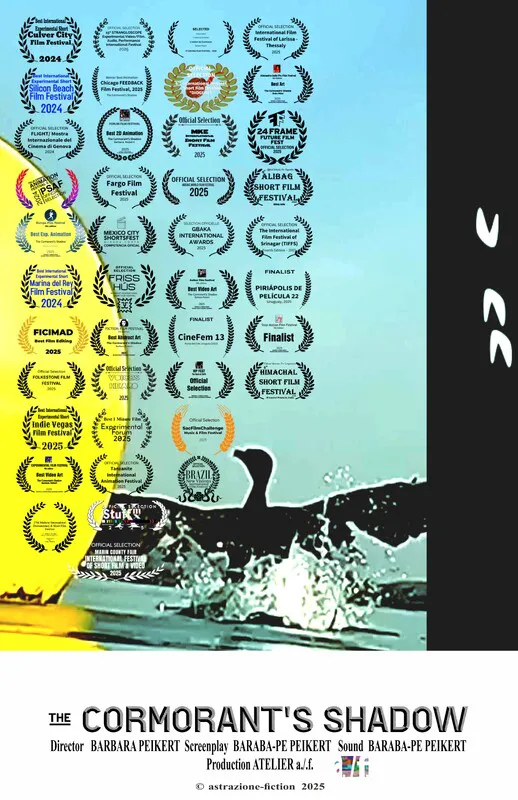
"The Cormorant’s Shadow" by Barbara Peikert, which lasts just one minute, showed me how I can sum up in such a short time, the concentrated attention (which is usually dispersed), on a cormorant resting on the buoy of a lake, while showing silhouettes of wings animated in 2D and flight maneuvers. And I won’t explain anything, Barbara will. Let’s be aware that this is conceptual art, and conceptual art always requires an explanation.
This one-minute animation is the first of a series of ultra-short animations that integrate seamlessly with all types of presentations, as they convey a sense of participation and ease. Its interaction with birds illustrates the environmental adaptation challenges faced by all species.
What is behind the cormorant resting on the buoy? He was caught drying his wings. Turn on the buoy as animated 2D wing silhouettes and flight maneuvers are shown. The cormorant immerses the viewer in a world of automated and stylized representation. Is there a conscious dimension and an unconscious one? The cormorant dives into the water, perhaps a little irritated, perhaps for fear of having its wings or those of another species cut off. Why is the cormorant pink and purple when it emerges from the water and returns to the buoy?
When we empathize with the cormorant, we make our own their powerlessness.
It is also intended to show the great ability of animals to constantly explore new behaviors and, in contrast with language without verbal meaning, trigger feelings and emotional affections.
“The Cormorant's Shadow” uses experimental resources to explore animation by integrating real footage as if it were the 3D indicator of 2D animation.
I liked to see it and understand the explanation.
Te puede interesar



Lo más visto